> For the complete documentation index, see [llms.txt](https://docs.responsiveads.com/llms.txt). Markdown versions of documentation pages are available by appending `.md` to page URLs; this page is available as [Markdown](https://docs.responsiveads.com/deploying-ads/ad-serving-tags/google-ad-manager-gam-setup-custom-creatives.md).
# Google Ad Manager (GAM) Setup: Custom Creatives
Follow this guide to integrate your ResponsiveAds creative into GAM as a Custom Creative. Covers tag setup, pixel tracking, and click-through verification.
## **Step 1: Retrieve Your ResponsiveAds Tag**
1. Log in to your **ResponsiveAds dashboard**.
2. Navigate to the **Summary Page** for your creative.
3. Scroll to the **Ad Tags and Deployments** section.
4. Confirm that the **Clickthrough field** in your Deployment includes a backup or default URL.
5. Select **Save Deployment**.
6. Select **Publish**.
7. Locate and select your **GAM Custom Tag**.
8. Choose the appropriate tag type.
9. Click **Copy to Clipboard** to copy the one-tag code.
10. *(If a tag was provided by your team, retrieve it from your shared Tag Sheet in Google Drive.)*
***
## Step 2: Custom Creative in GAM
### Prerequisites
* You have an **Advertiser** set up in GAM.
* You know the **ad size** (e.g., 300×250) and have any assets ready (images/JS/HTML).
* All third-party pixels/trackers support **HTTPS**. (GAM requires SSL for macro expansion in many cases.)
### Create the Custom Creative
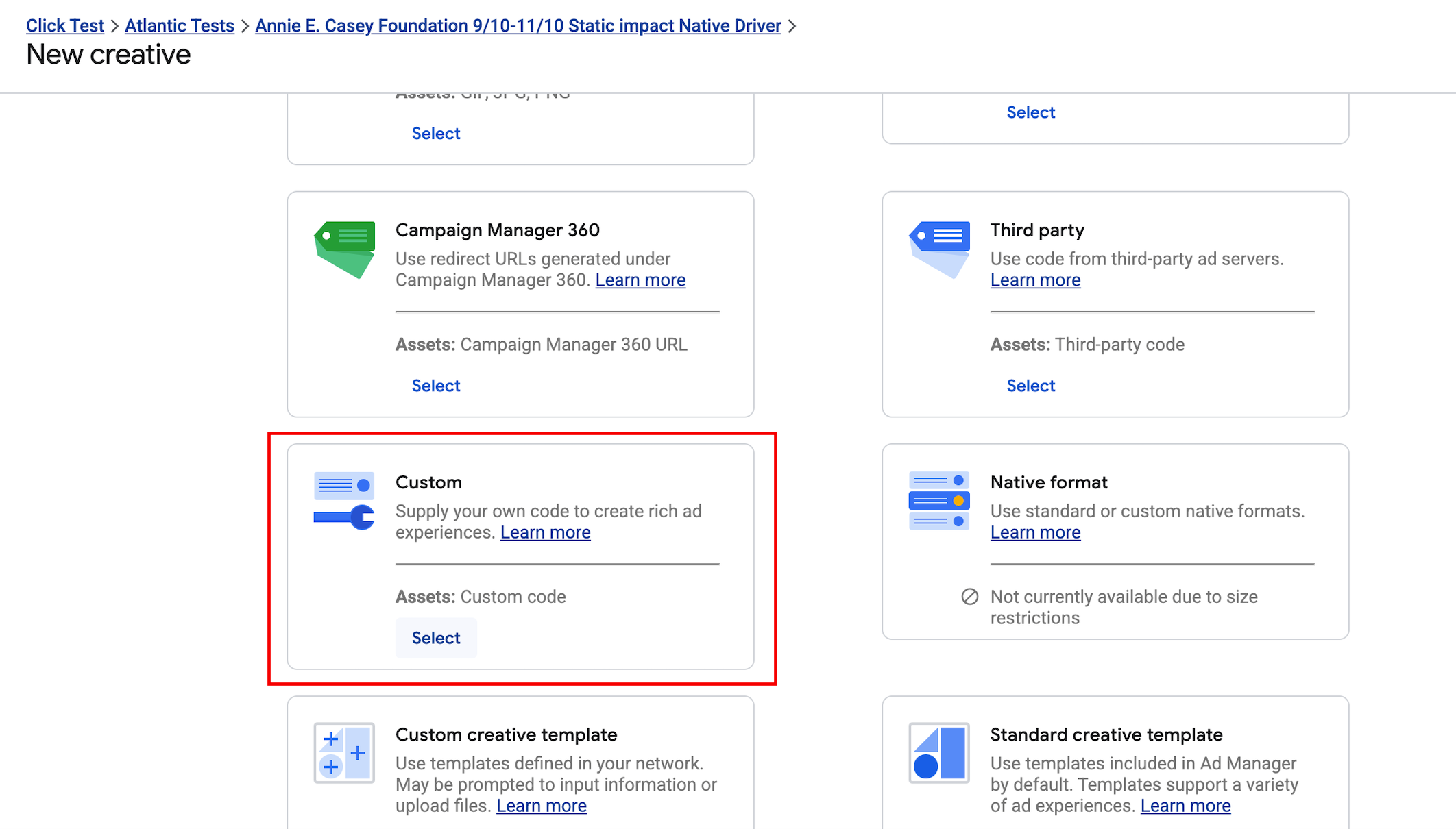
1. In GAM, go to **Delivery → Creatives → New creative**.
2. Select the **Advertiser**, then choose **Custom (Display creative type)**.
3. Enter a **Name** and select the **Target ad unit size**.
4. For **Code type**, choose **Standard**.
5. Deselect **SafeFrame**.
6. Click **Save**.
***
### Step 3: Add Your ResponsiveAds Tag
1. Open the Custom Creative you just created.
2. Paste your **ResponsiveAds GAM Custom Ad Tag** into the **Code field**.
3. Save your changes.
***
### Step 4: Add Tracking Pixels
You can add third-party tracking pixels in two ways:
**Option A: No-code (recommended)**
* In the creative, use the **Third-party impression tracking URLs** field.
* Add one or more pixel URLs.
* You can include macros such as `%%CACHEBUSTER%%`.
**Option B: Inline (advanced)**
* Add `` or `